TESTOSTERONE PROPIONATE: EFFECTS, PROPERTIES AND RISKS
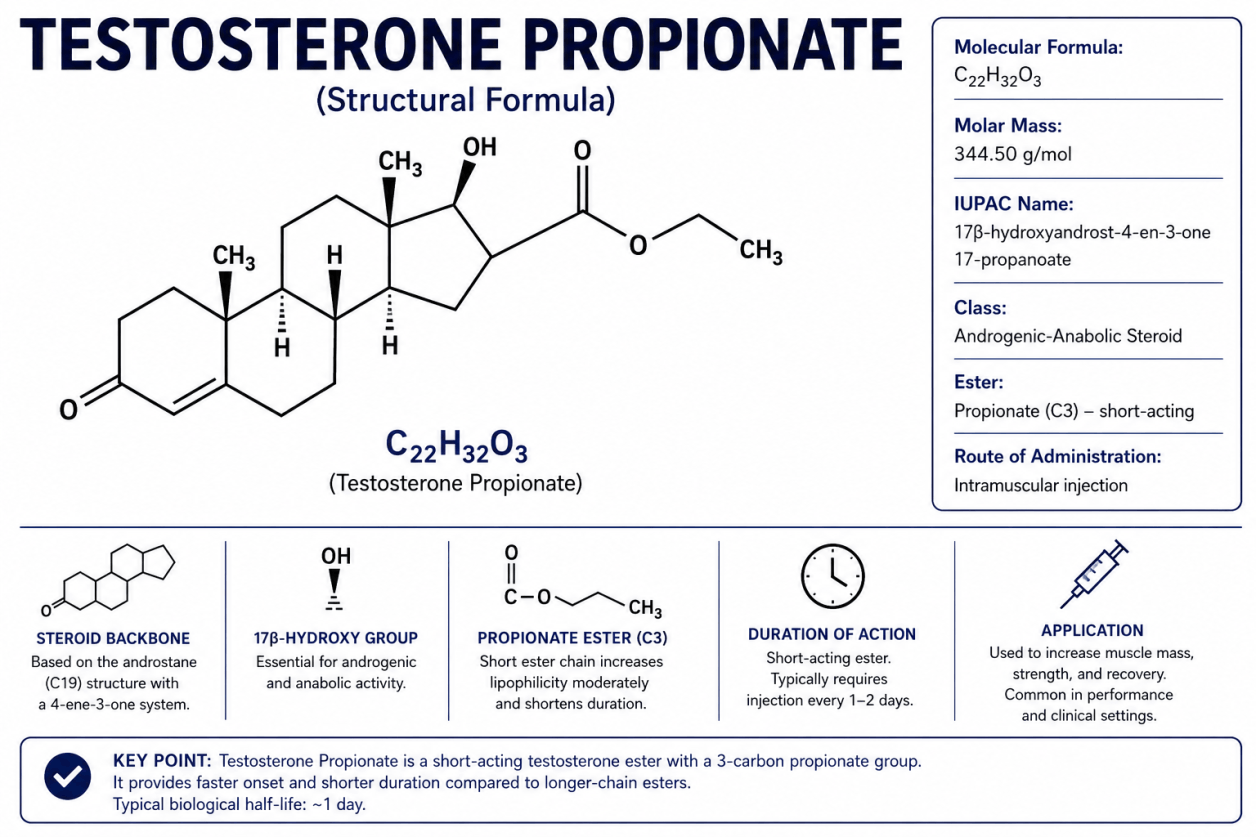
Testosterone Propionate belongs to the group of short-acting testosterone esters and has been known as a testosterone preparation for many decades. Due to its comparatively short duration of action, it differs pharmacologically from longer-acting esters such as Testosterone Enanthate or Testosterone Cypionate.
The properties of Testosterone Propionate are frequently discussed in connection with bodybuilding, muscle growth and testosterone replacement therapy. It is particularly important, however, to clearly distinguish between medically indicated use and non-medical use.
WHAT IS TESTOSTERONE PROPIONATE?
Testosterone Propionate is an ester of the body's naturally occurring hormone testosterone. By combining testosterone with propionic acid, the main change concerns the release of the hormone following intramuscular administration.
Compared with longer-acting testosterone esters, Testosterone Propionate is absorbed more rapidly and has a shorter duration of action. Studies describe a relatively rapid increase in testosterone concentrations in the blood following intramuscular administration.
The ester itself does not fundamentally alter the hormonal activity of testosterone. Once the ester is cleaved, testosterone becomes biologically active.
HOW DOES TESTOSTERONE WORK IN THE BODY?
Testosterone is one of the body's most important androgens. Among other functions, it influences the development and function of the male reproductive system, sexual function and various processes involving muscle and bone tissue.
Its effects occur partly through binding to the androgen receptor. Depending on the tissue involved, this can result in different biological responses.
Testosterone can also be converted into other hormones or hormonally active substances. Its effects are therefore not limited exclusively to direct activation of the androgen receptor.
TESTOSTERONE PROPIONATE AND MUSCLE GROWTH
In strength training, Testosterone Propionate is frequently associated with muscle growth, increased strength and improved physical performance.
Testosterone has both anabolic and androgenic properties. An increase in testosterone activity can therefore influence various processes that are relevant to muscle tissue.
It is important to note, however, that a stronger hormonal effect does not automatically mean safe or sustainable muscle growth. Particularly with non-medical use, high hormone levels can be associated with significant health risks.
WHY IS PROPIONATE CONSIDERED SHORT-ACTING?
The key difference compared with many other testosterone esters lies in the ester structure.
Testosterone Propionate has a short ester chain. As a result, following an intramuscular injection, the compound is released comparatively quickly and subsequently hydrolysed. Scientific literature describes a considerably shorter half-life than that of longer-acting testosterone esters.
This can result in relatively rapid changes in testosterone concentrations. At the same time, the shorter duration of action means that medical treatment with such preparations requires careful planning and monitoring by a healthcare professional.
TESTOSTERONE PROPIONATE VS. TESTOSTERONE ENANTHATE
Both preparations are based on testosterone, but they differ in terms of their ester structure and pharmacokinetic properties.
Testosterone Propionate
* Short testosterone ester
* Comparatively rapid onset of action
* Shorter duration of action
* Greater fluctuations in blood concentrations may occur
Testosterone Enanthate
* Longer-acting testosterone ester
* Slower release
* Longer duration of action
* Longer intervals between administrations may be possible
The choice of a testosterone preparation for medically indicated treatment should be made in consultation with a doctor or other qualified healthcare professional.
POSSIBLE SIDE EFFECTS
Testosterone is not a substance without side effects. Adverse effects may occur even when treatment is medically supervised.
Possible effects associated with testosterone therapy include:
* Acne and oilier skin
* Changes in libido
* Hair loss in individuals with a genetic predisposition
* Increased haematocrit and/or red blood cell count
* Suppression of the body's natural testosterone production
* Reduced sperm production
* Mood changes
* Pain or reactions at the injection site
* Fluid retention
Suppression of the body's natural sperm production and possible impairment of fertility are important considerations when undergoing testosterone therapy.
TESTOSTERONE PROPIONATE AND THE CARDIOVASCULAR SYSTEM
The relationship between testosterone therapy and cardiovascular risks is scientifically complex. Various factors, including dosage, underlying health, duration of treatment and the testosterone concentrations achieved, play a role.
One recognised issue associated with testosterone treatment can be an **increase in haematocrit**. This can affect blood viscosity. Regular monitoring is therefore important during medically supervised testosterone therapy.
A blanket statement that testosterone is inherently either beneficial or harmful to the cardiovascular system would therefore not adequately reflect the current evidence.
TESTOSTERONE PROPIONATE AND REPRODUCTION
One frequently underestimated aspect is the effect of externally administered testosterone on the body's natural hormone production.
Through the feedback relationship between the brain, pituitary gland and testes, externally administered testosterone can reduce the body's own testosterone production. At the same time, sperm production may decrease.
Anyone wishing to have children should therefore discuss a planned or existing testosterone therapy with a doctor.
MEDICAL USE AND BODYBUILDING SHOULD NOT BE CONFUSED
Testosterone preparations may form part of medically supervised treatment in people with a clinically diagnosed testosterone deficiency.
Use for performance enhancement or muscle growth outside a medical indication is clearly different. In particular, high or medically unsupervised doses may increase the risk of adverse effects.
Information about Testosterone Propionate should therefore not be understood as instructions for self-administration.
SAFETY INFORMATION
Testosterone Propionate is a hormonally active medicinal substance and not an ordinary food supplement.
Self-administration, changes to dosage or combination with other hormonally active substances can involve health risks. These may include changes to blood parameters, impaired fertility, skin changes, hormonal disturbances and possible cardiovascular complications.
If testosterone deficiency is suspected for medical reasons, symptoms, blood tests and possible underlying causes should be assessed by a healthcare professional. Testosterone therapy should be medically supervised and monitored regularly.
CONCLUSION
Testosterone Propionate is a short-acting testosterone ester with characteristic pharmacokinetic properties. Compared with longer-acting testosterone esters, it is released more rapidly and has a shorter duration of action.
For bodybuilding and strength training, the strong anabolic and androgenic activity of testosterone is particularly relevant. At the same time, potential risks should not be overlooked. In particular, its effects on the body's natural hormone production, fertility, blood parameters and cardiovascular system make responsible consideration of the subject important.
Testosterone Propionate should therefore not be viewed as a simple route to increased muscle mass, but as a pharmacologically active hormonal substance whose use requires appropriate medical knowledge and monitoring.