OXANDROLONE (ANAVAR): EFFECTS, PROPERTIES & HEALTH RISKS
Oxandrolone, historically marketed under
the trade names Anavar and Oxandrin,
is a synthetic, orally active
anabolic-androgenic steroid (AAS)
derived from dihydrotestosterone (DHT).
The compound was developed for medical purposes
and has been used in selected clinical situations
involving severe weight loss, tissue catabolism
and recovery from certain illnesses or injuries.
Its current regulatory status and availability
vary between countries. Historical medical
applications should not be confused with
current product authorisation.
Oxandrolone is also widely discussed in
bodybuilding, strength training and doping
because of its anabolic properties and its
reputation for comparatively limited
water retention.
However, claims that Anavar is a particularly
"mild" or "safe" anabolic steroid
are medically misleading.
Oxandrolone can adversely affect
liver function, blood lipid levels,
natural hormone production, fertility
and cardiovascular health.
This article explains its chemical properties,
biological activity, medical background
and potential health risks.
WHAT IS OXANDROLONE?
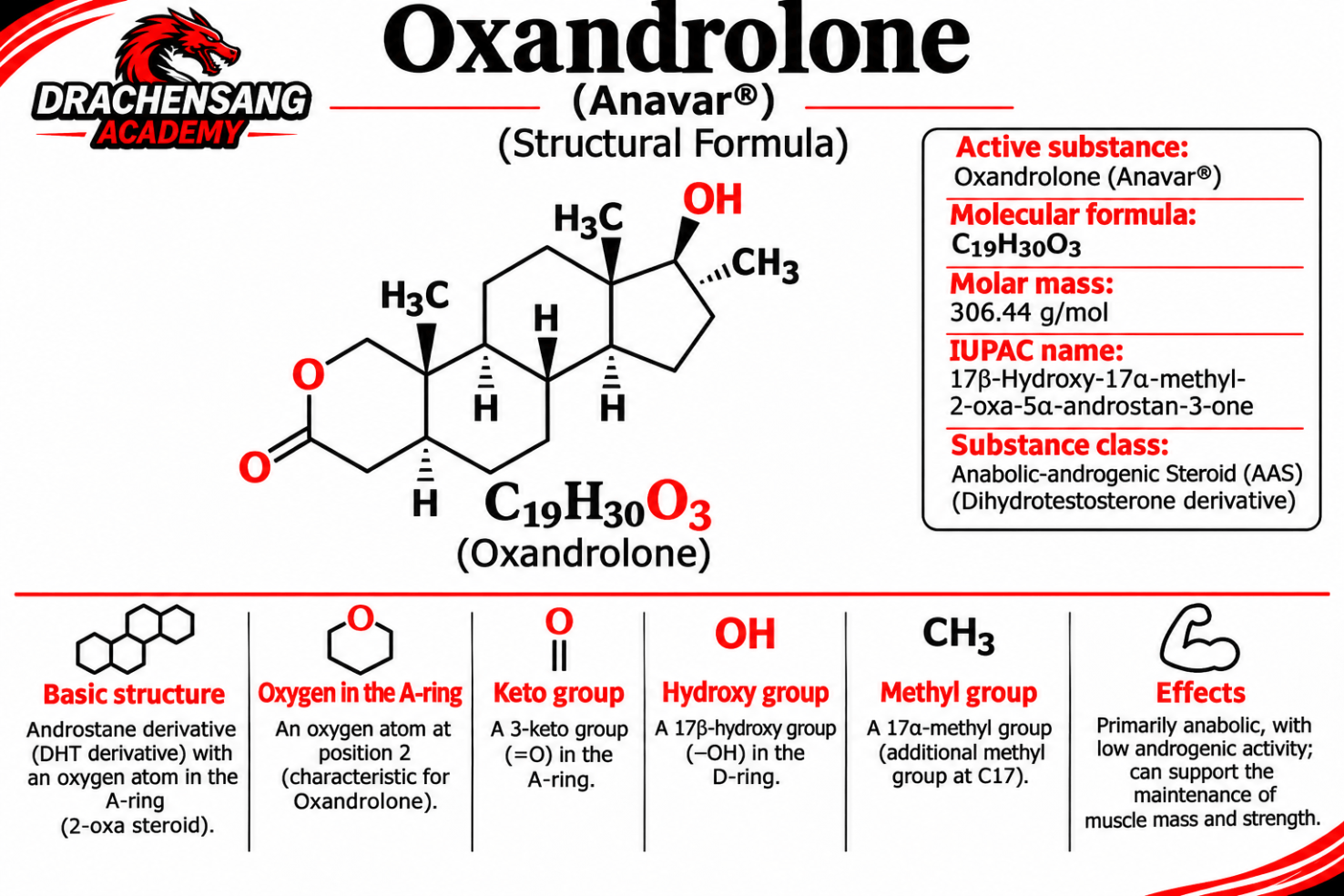
Oxandrolone is a synthetic anabolic-androgenic
steroid structurally derived from
dihydrotestosterone (DHT).
Its chemical structure includes an oxygen atom
incorporated into the steroid ring system
and a modification at the 17-alpha position.
Oxandrolone has the molecular formula
C19H30O3 and a molecular mass
of approximately 306.44 g/mol.
These structural modifications contribute
to its pharmacological properties,
including oral activity.
Like other anabolic-androgenic steroids,
oxandrolone acts through androgen receptors
in responsive tissues.
Its effects are not restricted to skeletal
muscle and can influence several
physiological systems.
Oxandrolone is a pharmacologically active
steroid compound, not an ordinary
nutritional supplement.
HOW DOES OXANDROLONE WORK IN THE BODY?
Oxandrolone has both anabolic and
androgenic properties.
Its biological activity involves interaction
with androgen receptors and changes in
androgen-responsive cellular processes.
These processes include aspects of
protein metabolism, tissue maintenance
and the regulation of certain
androgen-dependent characteristics.
Oxandrolone is not generally considered
to undergo direct aromatisation
into oestrogens.
However, this does not eliminate
hormonal side effects or
other health risks.
The absence of direct aromatisation
should not be interpreted as evidence
that oxandrolone is safe.
HISTORICAL MEDICAL APPLICATIONS OF OXANDROLONE
Oxandrolone has historically been used
in selected medical circumstances
involving involuntary weight loss
and tissue catabolism.
These have included certain conditions
associated with prolonged illness,
major surgery or severe injury.
The compound has also been investigated
in other specialist clinical settings.
However, its historical use does not
establish that it remains authorised
or recommended for every such condition.
In the United States, the FDA withdrew
approval of Oxandrin and certain generic
oxandrolone products in 2023 after
determining that the medicines had
not been shown to be safe and effective
for their approved indications.
Regulatory decisions and available
treatment options may differ
between countries.
Oxandrolone should not be presented
as a generally approved treatment
for muscle development or
athletic performance.
OXANDROLONE AND MUSCLE DEVELOPMENT
Oxandrolone is frequently discussed
in bodybuilding because of
its anabolic properties.
Anabolic-androgenic steroids can
influence protein metabolism
and androgen receptor activity
in skeletal muscle.
Claims commonly associated
with Anavar include:
• Increased muscle mass
• Changes in body composition
• Increased strength
• Preservation of muscle tissue during energy restriction
• Comparatively limited water retention
However, these claims must be
distinguished from established
clinical evidence and
authorised medical indications.
Changes in muscle mass or physical
appearance do not establish
long-term health benefits.
Non-medical use for physique
enhancement may expose individuals
to significant health risks.
WHY IS ANAVAR DESCRIBED AS A "MILD" STEROID?
Within bodybuilding communities,
oxandrolone is often described
as a comparatively mild
anabolic-androgenic steroid.
This reputation is partly associated
with its pharmacological characteristics
and the perception that certain
androgenic effects may be less pronounced
than those of some other steroids.
However, "mild" is not a
recognised medical safety classification.
Oxandrolone can cause serious
adverse effects even when
some visible androgenic changes
are less prominent.
Important concerns include:
• Liver injury
• Unfavourable cholesterol changes
• Suppression of natural hormone production
• Impaired fertility
• Cardiovascular complications
A substance cannot be considered
harmless simply because certain
side effects are less noticeable.
OXANDROLONE AND LIVER HEALTH
Liver-related adverse effects
are an important safety concern
with oxandrolone.
Oxandrolone is a
17-alpha-alkylated anabolic steroid,
a chemical modification associated
with oral activity.
This class of compounds is also
associated with clinically
significant liver injury.
Potential liver-related complications
include:
• Elevated liver enzyme levels
• Cholestatic liver injury
• Jaundice
• Peliosis hepatis
• Hepatic tumours
• Other serious liver abnormalities
Some complications are uncommon,
but they may be severe.
Symptoms requiring prompt
medical assessment include:
• Yellowing of the skin or eyes
• Dark urine
• Persistent nausea
• Unexplained abdominal pain
• Unusual fatigue
• Loss of appetite
Suspected liver injury requires
medical evaluation rather than
independent treatment.
OXANDROLONE AND CHOLESTEROL LEVELS
Oxandrolone can adversely affect
blood lipid concentrations.
Documented changes associated
with androgenic steroid exposure
include:
• Reduced high-density lipoprotein (HDL) cholesterol
• Increased low-density lipoprotein (LDL) cholesterol
• Changes in overall lipid metabolism
HDL cholesterol is involved
in transporting cholesterol
away from peripheral tissues.
LDL cholesterol contributes
to cholesterol transport
throughout the body.
An unfavourable lipid profile
can contribute to the
development of atherosclerosis
and cardiovascular disease.
Visible changes in body composition
do not reveal whether cholesterol
levels are being adversely affected.
OXANDROLONE AND CARDIOVASCULAR HEALTH
Cardiovascular health is an
important consideration when
evaluating anabolic-androgenic steroids.
Research involving non-medical
anabolic steroid exposure has
identified associations with
cardiovascular abnormalities.
Potential concerns include:
• Unfavourable blood lipid levels
• Increased blood pressure
• Changes in cardiac structure or function
• Increased cardiovascular risk with prolonged misuse
However, findings from populations
using multiple anabolic steroids
cannot always be attributed
specifically to oxandrolone.
The exact cardiovascular risk
depends on individual health,
exposure and other factors.
Oxandrolone should not be
regarded as cardiovascularly
safe because it is perceived
as a mild anabolic steroid.
OXANDROLONE AND NATURAL HORMONE PRODUCTION
Externally administered
anabolic-androgenic steroids
can suppress the body's
natural hormonal regulation.
This involves feedback mechanisms
within the hypothalamic-pituitary-gonadal
(HPG) axis.
Androgen exposure can reduce
the release of luteinising
hormone (LH) and follicle-stimulating
hormone (FSH).
In males, this may suppress
natural testosterone production
and impair sperm development.
Potential consequences include:
• Reduced endogenous testosterone production
• Lower sperm counts
• Impaired fertility
• Testicular shrinkage
• Changes in libido
• Erectile difficulties
• Symptoms of hormonal deficiency after discontinuation
The extent and duration
of hormonal suppression
vary between individuals.
Recovery may take time
and is not guaranteed
in every case.
OXANDROLONE AND MALE FERTILITY
Male fertility can be
affected by external
androgen exposure.
Suppression of LH and FSH
can reduce the hormonal
signals required for
normal sperm production.
This may lead to
reduced sperm counts
or other reproductive
difficulties.
The severity and duration
of these effects
vary between individuals.
Men planning to have children
should discuss any history
of anabolic steroid use
with a qualified
healthcare professional.
OXANDROLONE AND WOMEN'S HEALTH
Oxandrolone can cause
androgen-dependent
changes in women.
Potential effects include:
• Increased facial or body hair
• Acne and oily skin
• Menstrual disturbances
• Deepening of the voice
• Changes in scalp hair growth
• Other signs of virilisation
Some changes, particularly
voice deepening, may
be irreversible.
Oxandrolone exposure during
pregnancy may harm
foetal development
and cause virilisation.
Oxandrolone must not
be used during pregnancy.
OXANDROLONE AND PSYCHOLOGICAL EFFECTS
Anabolic-androgenic steroid
exposure can also affect
psychological wellbeing.
Possible effects reported
in association with
AAS use include:
• Mood changes
• Irritability
• Sleep disturbances
• Anxiety symptoms
• Depressive symptoms
• Psychological dependence in some individuals
These findings are largely
derived from broader
research into anabolic
steroid exposure.
They do not establish
the frequency of each
effect specifically
for oxandrolone.
WHY ARE BLOOD TESTS IMPORTANT?
In medical settings,
laboratory monitoring
can help identify
treatment-related
adverse effects.
Depending on the
clinical circumstances,
relevant assessments
may include:
• Liver function tests
• Blood lipid concentrations
• Full blood count
• Relevant hormonal measurements
• Other investigations when clinically indicated
Monitoring requirements
depend on the medicine,
the patient and
applicable clinical guidance.
Normal laboratory results
do not guarantee that
non-medical anabolic
steroid exposure is safe.
OXANDROLONE IN BODYBUILDING
Oxandrolone is frequently
discussed in bodybuilding
and strength sports
under the name Anavar.
Online discussions often
focus on muscle definition,
strength and changes
in body composition.
However, bodybuilding
terminology and
anecdotal reports
do not constitute
reliable evidence
of medical safety.
For sustainable muscle
development, important
foundations include:
• Progressive resistance training
• Adequate energy and protein intake
• Sufficient sleep
• Appropriate recovery
• Consistent long-term training
Non-medical anabolic steroid use
is not a substitute for
evidence-based training
and nutrition.
OXANDROLONE AND DOPING
Oxandrolone is classified
as an anabolic agent
under the World
Anti-Doping Agency
(WADA) Prohibited List.
It is prohibited both
in and out of competition
under applicable
anti-doping rules.
Athletes should consult
the current WADA
Prohibited List
and the regulations
of their sporting
federation.
RISKS OF UNREGULATED ANAVAR PRODUCTS
Products marketed as
Anavar outside regulated
pharmaceutical supply
chains may present
additional risks.
Unregulated products
may be incorrectly
labelled, contaminated
or contain unexpected
active substances.
The actual composition
may differ from
the information
displayed on
the packaging.
Branding, product appearance
and marketing claims
do not establish
pharmaceutical quality
or medical safety.
IMPORTANT SAFETY INFORMATION
Oxandrolone is a
pharmacologically active
anabolic-androgenic steroid,
not an ordinary
nutritional supplement.
Non-medical use may
involve significant
health risks affecting
the liver, blood lipids,
cardiovascular system,
hormonal regulation
and fertility.
Some adverse effects
may persist after
exposure has ended.
This article is intended
exclusively for
general information
and educational purposes.
It does not recommend
self-administration,
non-medical use
or performance
enhancement with
oxandrolone.
No dosage, cycle
or combination
instructions
are provided.
Anyone experiencing
symptoms after
anabolic steroid
exposure should
seek appropriate
medical assessment.
CONCLUSION: UNDERSTANDING OXANDROLONE (ANAVAR)
Oxandrolone,
historically marketed
under the trade names
Anavar and Oxandrin,
is a synthetic
DHT-derived
anabolic-androgenic
steroid.
It has a history
of medical use
in selected
clinical conditions,
although its current
regulatory status
differs between
countries.
The compound is
widely discussed
in bodybuilding,
but claims that
it is particularly
mild or harmless
are not supported
by a reliable
clinical safety
classification.
Potential risks
include liver injury,
unfavourable cholesterol
changes, suppression
of natural testosterone
production, impaired
fertility and
cardiovascular
complications.
Oxandrolone should
therefore be understood
as a pharmacologically
active steroid compound,
not as a risk-free
method of increasing
muscle mass or
athletic performance.
Responsible evaluation
requires consideration
of established
medical evidence,
regulatory information
and individual
health risks.