ORAL TURINABOL (DHCMT): EFFECTS, RISKS & DOPING
Oral Turinabol, also known as dehydrochloromethyltestosterone (DHCMT) or 4-chlorodehydromethyltestosterone, is a synthetic, orally active anabolic-androgenic steroid (AAS) derived from testosterone.
Developed in the 1960s, the compound became particularly well known through its historical association with state-sponsored doping in the former East Germany.
Oral Turinabol is also discussed in bodybuilding, strength sports and competitive athletics because of its anabolic properties and its association with muscle development and performance enhancement.
However, the compound is a 17-alpha-alkylated anabolic steroid, a structural characteristic associated with increased oral activity and potential liver toxicity.
Other important health concerns include unfavourable changes in blood lipids, suppression of natural hormone production, impaired fertility and cardiovascular complications.
This article explains the chemical properties, biological activity, historical background, potential adverse effects and anti-doping significance of Oral Turinabol.
WHAT IS ORAL TURINABOL?
Oral Turinabol is the historical trade name associated with the synthetic anabolic-androgenic steroid dehydrochloromethyltestosterone (DHCMT).
The compound is structurally related to testosterone and contains several chemical modifications that influence its pharmacological characteristics.
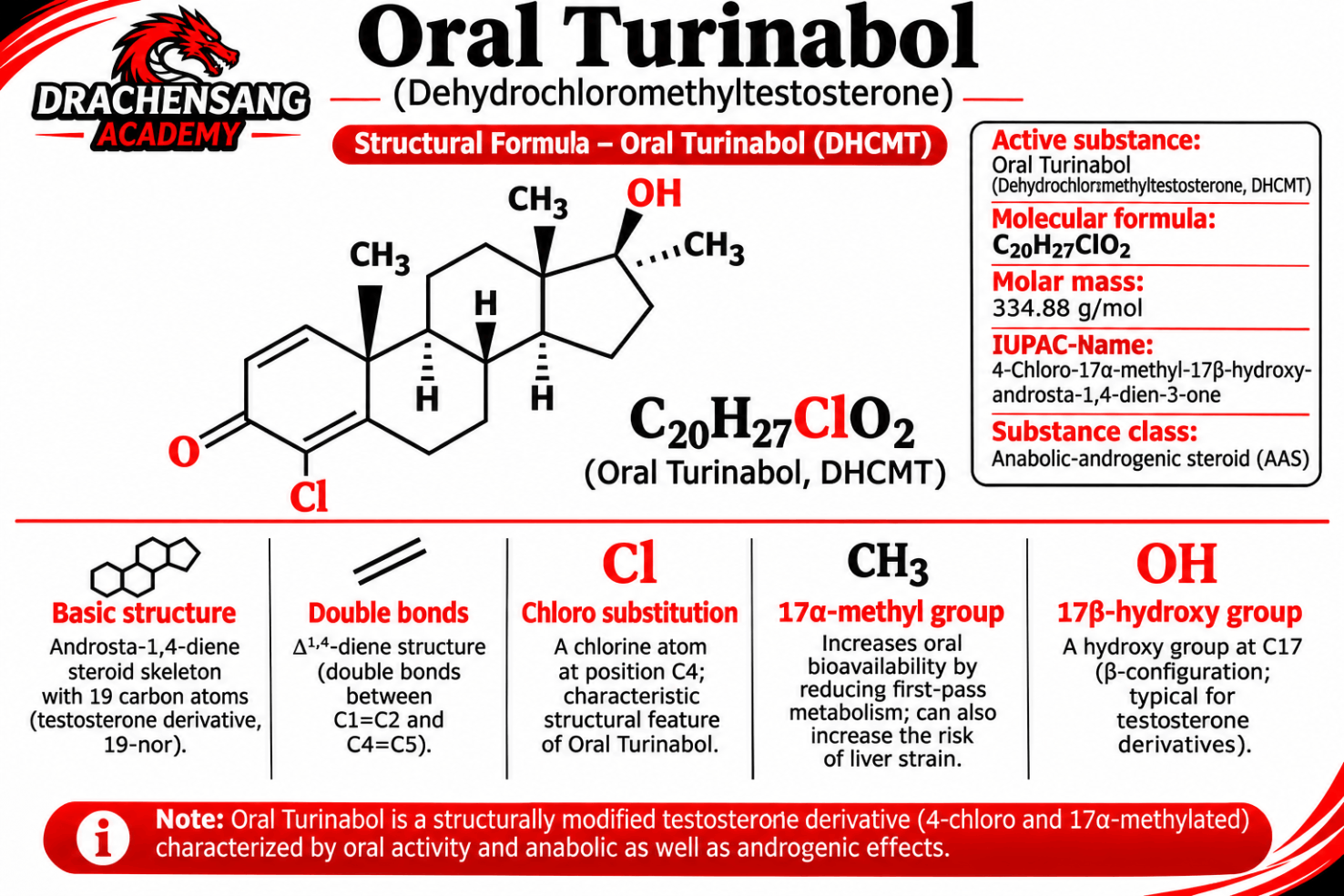
Its molecular formula is C20H27ClO2, and its molecular mass is approximately 334.88 g/mol.
Important structural characteristics include:
• A testosterone-derived steroid framework
• A chlorine substituent at carbon 4
• An additional double bond between carbon atoms 1 and 2
• A 17-alpha-methyl group associated with oral activity
These modifications distinguish DHCMT from testosterone and contribute to its pharmacological properties.
Oral Turinabol is a pharmacologically active anabolic-androgenic steroid, not an ordinary nutritional supplement.
HOW DOES ORAL TURINABOL WORK IN THE BODY?
Like other anabolic-androgenic steroids, DHCMT acts through androgen receptor signalling.
Androgen receptors are present in several tissues and are involved in regulating androgen-responsive biological processes.
These processes include aspects of protein metabolism, tissue maintenance and reproductive hormonal regulation.
Anabolic activity can influence muscle-related processes, while androgenic activity affects other tissues and physiological functions.
DHCMT is not generally considered to undergo direct aromatisation into oestrogens.
However, this characteristic does not eliminate the possibility of hormonal disturbances or other adverse effects.
The absence of direct aromatisation should not be interpreted as evidence that Oral Turinabol is safe.
WHY IS ORAL TURINABOL ORALLY ACTIVE?
Oral Turinabol contains a 17-alpha-methyl group, a structural modification that contributes to its activity following oral administration.
This modification reduces certain metabolic processes that would otherwise limit the oral activity of some steroid compounds.
However, 17-alpha-alkylation is also associated with an increased potential for liver-related adverse effects.
The compound undergoes metabolism following absorption, producing several metabolites.
Some metabolites are particularly relevant to anti-doping analysis because they can be identified in biological samples.
Oral administration does not make an anabolic steroid safer than other forms of exposure.
THE HISTORY OF ORAL TURINABOL
Oral Turinabol was developed during the 1960s in the former East Germany.
The compound became closely associated with the country's historical system of state-organised doping in competitive sport.
Historical investigations and research have documented the use of anabolic steroids in programmes intended to enhance athletic performance.
Oral Turinabol became one of the substances most strongly associated with this period.
Its historical significance extends beyond pharmacology because it illustrates the ethical, medical and sporting consequences of systematic performance-enhancing drug use.
The history of Oral Turinabol demonstrates why performance enhancement must be considered alongside athlete health, informed consent and anti-doping regulations.
ORAL TURINABOL AND MUSCLE DEVELOPMENT
Oral Turinabol is frequently discussed in bodybuilding because of its anabolic properties.
Claims commonly associated with the compound include:
• Increased muscle mass
• Changes in protein metabolism
• Increased strength
• Changes in body composition
• Improved physical performance
However, these claims must be distinguished from reliable clinical evidence and authorised medical indications.
The historical use of DHCMT for performance enhancement does not establish that it provides a safe or medically acceptable benefit.
Changes in muscle mass or strength do not necessarily reflect the effects occurring in the liver, cardiovascular system or hormonal system.
Potential anabolic activity should not be confused with an acceptable long-term safety profile.
WHY IS ORAL TURINABOL SOMETIMES DESCRIBED AS "MILD"?
Within bodybuilding communities, Oral Turinabol is sometimes described as a comparatively mild anabolic steroid.
This reputation is partly associated with claims about its androgenic characteristics and its limited direct conversion into oestrogens.
However, "mild" is not a recognised medical safety classification.
A steroid may cause fewer immediately noticeable symptoms while still producing clinically significant physiological changes.
Important concerns include:
• Liver injury
• Unfavourable cholesterol changes
• Suppression of natural testosterone production
• Impaired fertility
• Cardiovascular complications
Oral Turinabol should not be regarded as harmless because certain adverse effects may appear less noticeable.
ORAL TURINABOL AND LIVER HEALTH
Liver-related toxicity is an important concern with orally active 17-alpha-alkylated anabolic steroids.
DHCMT belongs to this chemical category.
Potential liver-related complications associated with this class of steroids include:
• Elevated liver enzyme levels
• Cholestatic liver injury
• Jaundice
• Peliosis hepatis
• Hepatic tumours
• Other serious liver abnormalities
Some of these complications are uncommon but may be severe.
The precise frequency of individual liver complications specifically attributable to DHCMT in humans is not well established.
Nevertheless, its chemical structure and the recognised risks of related anabolic steroids provide important reasons for concern.
Warning signs of possible liver injury include:
• Yellowing of the skin or eyes
• Dark urine
• Persistent nausea
• Unexplained abdominal pain
• Unusual fatigue
• Loss of appetite
Suspected liver injury requires appropriate medical assessment rather than independent treatment.
ORAL TURINABOL AND CHOLESTEROL LEVELS
Anabolic-androgenic steroids can adversely affect blood lipid concentrations.
Particularly concerning changes include:
• Reduced high-density lipoprotein (HDL) cholesterol
• Increased low-density lipoprotein (LDL) cholesterol
• Other unfavourable changes in lipid metabolism
HDL cholesterol is involved in transporting cholesterol away from peripheral tissues.
Elevated LDL cholesterol is associated with the development of atherosclerosis and cardiovascular disease.
The extent of these changes depends on the compound, exposure and individual characteristics.
Reliable human data specifically quantifying DHCMT-related lipid changes remain limited.
Changes in cholesterol levels may occur without obvious physical symptoms.
ORAL TURINABOL AND CARDIOVASCULAR HEALTH
Cardiovascular complications are among the recognised concerns associated with non-medical anabolic steroid use.
Research involving anabolic steroid users has identified associations with:
• Unfavourable blood lipid profiles
• Elevated blood pressure
• Changes in cardiac structure
• Impaired cardiac function
• Increased cardiovascular risk with prolonged misuse
However, many studies involve people using several different anabolic steroids.
Consequently, the findings cannot always be attributed specifically to Oral Turinabol.
The exact cardiovascular risk of DHCMT in humans has not been adequately quantified.
Limited compound-specific evidence does not establish cardiovascular safety.
ORAL TURINABOL AND NATURAL HORMONE PRODUCTION
Externally administered anabolic-androgenic steroids can interfere with the body's natural hormonal regulation.
This involves the hypothalamic-pituitary-gonadal (HPG) axis.
Androgen exposure can suppress the release of luteinising hormone (LH) and follicle-stimulating hormone (FSH).
In males, this may reduce natural testosterone production and interfere with sperm development.
Potential consequences associated with anabolic steroid exposure include:
• Suppression of endogenous testosterone production
• Reduced sperm production
• Impaired fertility
• Testicular shrinkage
• Changes in libido
• Erectile difficulties
• Symptoms of hormonal deficiency after discontinuation
The severity and duration of these effects vary between individuals.
Recovery of normal hormonal function may take time and cannot be guaranteed in every case.
Oral Turinabol should not be considered hormonally harmless simply because it does not directly aromatise into oestrogens.
ORAL TURINABOL AND MALE FERTILITY
Male fertility depends on the coordinated activity of reproductive hormones and the testes.
Suppression of LH and FSH can interfere with the hormonal signals required for normal sperm production.
Anabolic steroid exposure may therefore contribute to reduced sperm counts and other reproductive difficulties.
The extent and duration of fertility impairment vary between individuals.
Reliable human studies specifically examining DHCMT-related fertility outcomes are limited.
Men experiencing fertility problems after anabolic steroid exposure should seek assessment from an appropriately qualified healthcare professional.
ORAL TURINABOL AND WOMEN'S HEALTH
Anabolic-androgenic steroids can cause androgen-dependent changes in women.
Potential effects include:
• Increased facial or body hair
• Acne and oily skin
• Menstrual disturbances
• Deepening of the voice
• Changes in scalp hair growth
• Other signs of virilisation
Some changes, particularly voice deepening, may be irreversible.
Exposure to androgenic steroids during pregnancy may also pose risks to foetal development.
Oral Turinabol should not be regarded as safe for women or during pregnancy.
ORAL TURINABOL AND PSYCHOLOGICAL EFFECTS
Non-medical anabolic steroid exposure has also been associated with psychological and behavioural changes.
Reported concerns include:
• Mood changes
• Irritability
• Sleep disturbances
• Anxiety symptoms
• Depressive symptoms
• Psychological dependence in some individuals
These findings are largely derived from broader research involving anabolic-androgenic steroids.
They do not establish the frequency of individual psychological effects specifically associated with DHCMT.
ORAL TURINABOL AND DOPING
Oral Turinabol is prohibited under the World Anti-Doping Agency (WADA) Prohibited List.
DHCMT is classified under S1 – Anabolic Agents and is prohibited both in and out of competition.
Its historical association with doping makes it particularly significant in the development of modern anti-doping analysis.
Athletes should consult the current WADA Prohibited List and the regulations of their sporting federation.
WHY ARE ORAL TURINABOL METABOLITES IMPORTANT?
Following exposure, DHCMT undergoes metabolism and produces several breakdown products.
Some metabolites are particularly relevant to anti-doping laboratories.
Modern analytical techniques can identify characteristic metabolites in biological samples.
Research has identified metabolites that may remain detectable after the original compound is no longer readily measurable.
However, detection periods vary according to analytical methods, biological factors and the circumstances of exposure.
There is no universally reliable detection period that applies to every individual or testing situation.
The scientific study of DHCMT metabolites has contributed to improvements in anti-doping detection methods.
RISKS OF UNREGULATED ORAL TURINABOL PRODUCTS
Products marketed as Oral Turinabol outside regulated pharmaceutical supply chains may present additional risks.
Unregulated products may be incorrectly labelled, contaminated or contain unexpected active substances.
Their actual composition or concentration may differ from the information provided by the seller.
These uncertainties create risks beyond those associated with the pharmacological properties of DHCMT itself.
Product appearance, branding and marketing claims do not establish pharmaceutical quality or medical safety.
ORAL TURINABOL IS NOT A FOOD SUPPLEMENT
A clear distinction must be made between ordinary nutritional supplements and pharmacologically active anabolic steroids.
Protein supplements, creatine and certain vitamins may be used as part of sports nutrition.
Oral Turinabol, by contrast, is a synthetic anabolic-androgenic steroid that affects androgen-responsive biological systems.
It should therefore not be marketed or understood as an ordinary dietary supplement.
Its anabolic properties do not establish suitability for general fitness or muscle-building purposes.
IMPORTANT SAFETY INFORMATION
Oral Turinabol is a pharmacologically active anabolic-androgenic steroid, not a harmless fitness product or nutritional supplement.
Non-medical exposure may involve risks affecting liver function, blood lipids, cardiovascular health, hormonal regulation and fertility.
Some adverse effects may persist after exposure has ended.
This article is intended exclusively for general information and educational purposes.
It does not recommend self-administration, non-medical use or performance enhancement with Oral Turinabol.
No dosage, cycle or combination instructions are provided.
Anyone experiencing symptoms following anabolic steroid exposure should seek appropriate medical assessment.
CONCLUSION: UNDERSTANDING ORAL TURINABOL (DHCMT)
Oral Turinabol, also known as dehydrochloromethyltestosterone (DHCMT), is a synthetic, orally active anabolic-androgenic steroid developed during the 1960s.
The compound is historically associated with state-sponsored doping in the former East Germany and remains relevant to modern anti-doping analysis.
Although it is frequently discussed in bodybuilding in connection with muscle development and strength, its anabolic properties are accompanied by important health concerns.
Potential risks include liver injury, unfavourable cholesterol changes, suppression of natural testosterone production, impaired fertility and cardiovascular complications.
DHCMT is also prohibited under the WADA Prohibited List, and characteristic metabolites are relevant to doping controls.
Oral Turinabol should therefore be understood as a pharmacologically active anabolic-androgenic steroid with significant potential health risks, not as a safe or medically established method of improving muscle mass or athletic performance.
A responsible assessment requires consideration of established pharmacological knowledge, historical evidence, scientific research and the limitations of available human clinical data.