BOLDENONE: EFFECTS, PROPERTIES & HEALTH RISKS
Boldenone is a synthetic anabolic-androgenic steroid (AAS) structurally related to testosterone. It is particularly associated with boldenone undecylenate, an esterified preparation historically used in veterinary medicine.
The compound is also well known in bodybuilding and strength sports, where it is frequently discussed in connection with muscle development, strength and changes in body composition.
However, its anabolic properties are accompanied by potential risks involving hormonal regulation, cardiovascular health, blood parameters, fertility and other organ systems.
Reliable human clinical evidence specifically examining boldenone is limited. Much of the available compound-specific research involves laboratory investigations or experimental animal models.
This article explains the chemical characteristics of boldenone, its biological activity, veterinary background, potential health effects and the limitations of the available scientific evidence.
WHAT IS BOLDENONE?
Boldenone is a synthetic anabolic-androgenic steroid chemically related to testosterone.
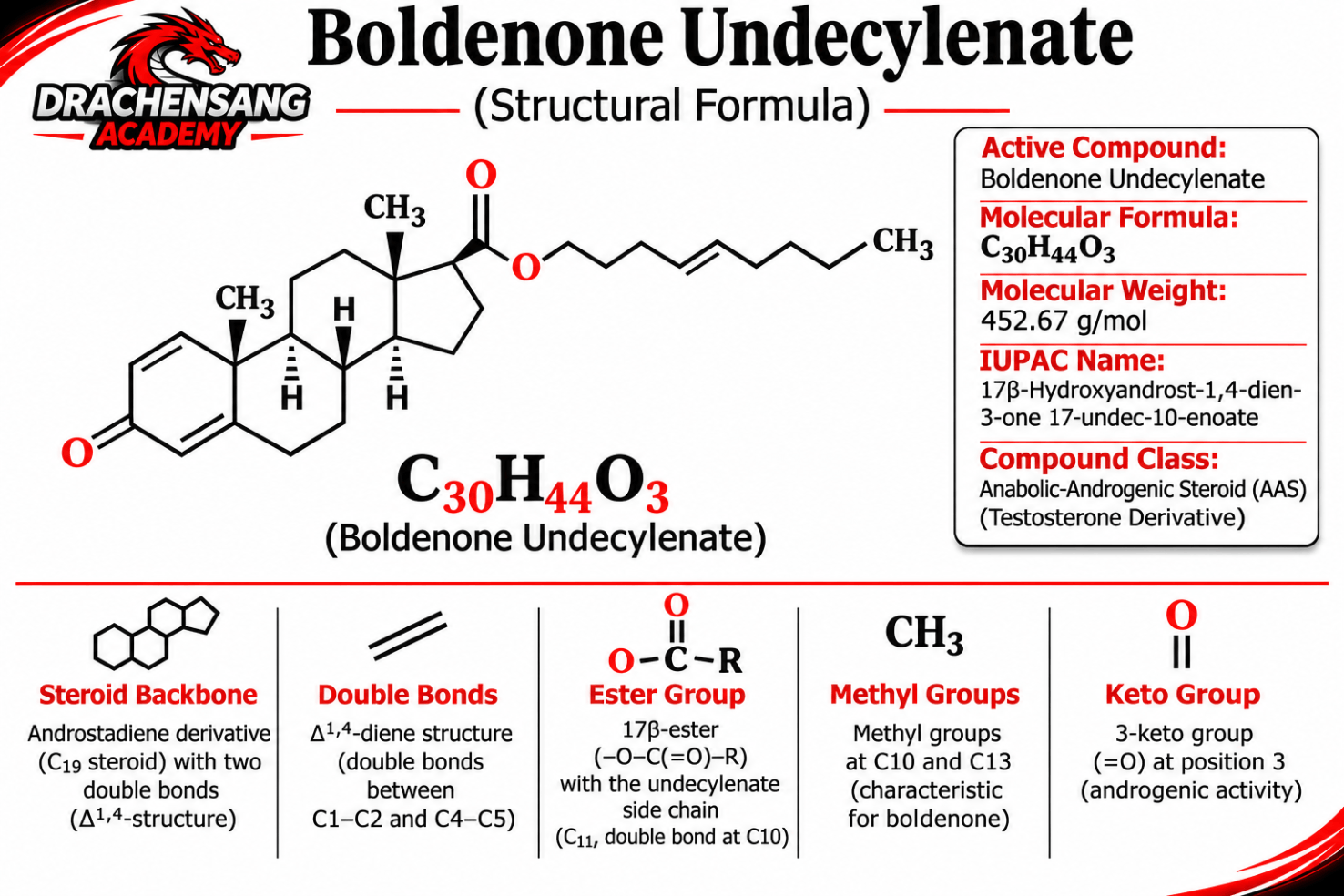
Its chemical name is androsta-1,4-dien-17β-ol-3-one, and its molecular formula is C19H26O2.
The molecule contains an additional double bond between carbon atoms 1 and 2 compared with testosterone.
This structural difference influences its pharmacological characteristics, although it does not eliminate the risks associated with androgen receptor activity.
Boldenone has both anabolic and androgenic properties and can influence biological processes in androgen-responsive tissues.
Boldenone is a pharmacologically active steroid compound, not an ordinary nutritional supplement.
BOLDENONE VS. BOLDENONE UNDECYLENATE
An important distinction exists between boldenone itself and its esterified derivative, boldenone undecylenate.
Boldenone is the active steroid molecule.
Boldenone undecylenate contains an undecylenate ester attached to the steroid structure. This modification changes the compound's physicochemical properties and allows prolonged release from certain injectable depot formulations.
Following ester cleavage, the active steroid is boldenone.
The undecylenate ester does not make the compound harmless or suitable for unsupervised human use.
Boldenone undecylenate is particularly associated with veterinary preparations rather than authorised human medical treatment.
VETERINARY BACKGROUND OF BOLDENONE
Boldenone undecylenate has historically been used in veterinary medicine, particularly in horses.
Its veterinary applications have involved anabolic effects and the management of certain clinical conditions under professional supervision.
However, veterinary authorisation does not establish safety or suitability for human treatment.
Veterinary medicines may differ from human medicines in their approved indications, formulation, manufacturing requirements and regulatory assessment.
Boldenone has no established authorised medical indication for human treatment.
The fact that a substance has been used in animals does not justify its use for human muscle development or athletic performance.
HOW DOES BOLDENONE WORK IN THE BODY?
Like other anabolic-androgenic steroids, boldenone interacts with androgen receptors in responsive tissues.
Androgen receptor signalling influences several biological processes, including aspects of protein metabolism, tissue maintenance and reproductive hormonal regulation.
Anabolic activity can influence muscle-related processes, while androgenic activity affects other tissues and physiological functions.
Boldenone may also interfere with the body's natural hormonal feedback mechanisms.
Consequently, its effects cannot be assessed solely by considering muscle development or physical appearance.
Androgen receptor activity can affect multiple organ systems, not just skeletal muscle.
BOLDENONE AND MUSCLE DEVELOPMENT
Boldenone is frequently discussed in bodybuilding because of its association with muscle growth and strength development.
Claims commonly associated with the compound include:
• Increased muscle mass
• Changes in body composition
• Increased strength
• Changes in protein metabolism
• Improved physical performance
However, reliable controlled clinical studies specifically evaluating boldenone for muscle development in healthy humans are lacking.
Reports from bodybuilding communities cannot establish the magnitude, consistency or safety of these claimed effects.
Training status, nutrition, genetics, other substances and underlying health conditions may substantially influence reported outcomes.
Potential anabolic activity should not be confused with an established medical benefit or acceptable safety profile.
WHY IS BOLDENONE SOMETIMES DESCRIBED AS "MILD"?
Within bodybuilding communities, boldenone is sometimes described as a comparatively mild anabolic steroid.
Such descriptions are generally based on anecdotal experiences, perceived differences between compounds and claims about particular side effects.
However, "mild" is not a recognised clinical safety classification.
A steroid may cause relatively few immediately noticeable symptoms while still affecting blood parameters, hormonal regulation or cardiovascular health.
The absence of obvious side effects does not establish the absence of physiological harm.
Boldenone should not be considered harmless simply because some users report fewer visible adverse effects.
BOLDENONE AND NATURAL HORMONE PRODUCTION
Exogenous anabolic-androgenic steroids can interfere with the body's natural hormonal regulation.
This involves the hypothalamic-pituitary-gonadal (HPG) axis, which helps regulate testosterone production and reproductive function.
External androgen exposure can suppress the release of luteinising hormone (LH) and follicle-stimulating hormone (FSH).
In males, this may reduce natural testosterone production and impair sperm development.
Potential consequences associated with anabolic steroid exposure include:
• Suppression of endogenous testosterone production
• Reduced sperm production
• Impaired fertility
• Testicular shrinkage
• Changes in libido
• Erectile difficulties
• Hormonal deficiency symptoms after discontinuation
The severity and duration of these effects vary between individuals.
Recovery of normal hormonal function may take considerable time and cannot be guaranteed in every case.
Although these mechanisms are recognised for anabolic-androgenic steroids, precise human risk estimates specifically for boldenone remain limited.
BOLDENONE AND MALE FERTILITY
Reproductive health is an important concern with anabolic-androgenic steroid exposure.
Suppression of LH and FSH can interfere with the hormonal signals required for normal sperm production.
Experimental studies involving male animals exposed to boldenone undecylenate have reported changes in testosterone concentrations, sperm characteristics and reproductive tissues.
Reported findings have included:
• Reduced testosterone concentrations
• Changes in sperm count
• Reduced sperm motility
• Alterations in testicular tissue
• Changes affecting reproductive organs
However, animal findings cannot automatically be translated into specific effects or risk estimates for humans.
These studies nevertheless support concerns about possible reproductive toxicity.
Men who have used anabolic steroids and experience fertility problems should seek assessment from an appropriately qualified healthcare professional.
BOLDENONE AND BLOOD PARAMETERS
Androgens can stimulate erythropoiesis, the process by which the body produces red blood cells.
Excessive increases in red blood cell production may contribute to elevated haemoglobin concentrations and haematocrit.
An abnormally high haematocrit can increase blood viscosity and may contribute to circulatory complications.
Potential concerns include:
• Increased red blood cell concentrations
• Elevated haemoglobin
• Increased haematocrit
• Changes in blood viscosity
• Possible circulatory complications
The extent of these effects specifically attributable to boldenone in humans has not been adequately quantified.
Changes in blood parameters may occur without immediately noticeable symptoms.
BOLDENONE AND CARDIOVASCULAR HEALTH
Cardiovascular complications are an important concern associated with non-medical anabolic-androgenic steroid use.
Research involving AAS users has identified associations with changes in blood pressure, lipid metabolism and cardiac structure or function.
Potential concerns include:
• Elevated blood pressure
• Unfavourable changes in cholesterol levels
• Changes in cardiac structure
• Impaired cardiac function
• Increased cardiovascular risk with prolonged misuse
However, many studies involve individuals using several different anabolic steroids.
Consequently, the findings cannot always be attributed to boldenone alone.
The exact cardiovascular risk of boldenone in humans remains insufficiently characterised.
Limited compound-specific evidence should not be interpreted as proof of cardiovascular safety.
POTENTIAL EFFECTS ON THE KIDNEYS
Kidney health is another area of concern when evaluating anabolic-androgenic steroid exposure.
Experimental animal studies involving boldenone have reported changes in kidney-related laboratory parameters and renal tissue structure.
Such findings suggest possible kidney-related toxicity under the experimental conditions examined.
However, animal studies cannot establish the frequency or severity of kidney injury in humans exposed to boldenone.
Broader research into anabolic steroid misuse has also identified associations with kidney abnormalities, although other factors may contribute.
These include elevated blood pressure, dehydration, other substances and underlying medical conditions.
Persistent changes in kidney function or abnormal laboratory findings require appropriate medical assessment.
BOLDENONE AND LIVER HEALTH
The liver-related effects of anabolic steroids vary according to their chemical structure and formulation.
Certain orally active 17-alpha-alkylated anabolic steroids are particularly associated with clinically significant liver injury.
Boldenone is not a conventional 17-alpha-alkylated anabolic steroid.
Nevertheless, this chemical distinction does not establish that boldenone is free from liver-related risks.
Experimental research has investigated possible effects of boldenone exposure on liver tissue and biochemical parameters.
Reliable human evidence specifically quantifying boldenone-related liver injury remains limited.
The absence of a particular chemical risk factor does not guarantee overall safety.
BOLDENONE AND WOMEN'S HEALTH
Anabolic-androgenic steroids can cause androgen-dependent changes in women.
Potential effects include:
• Increased facial or body hair
• Acne and oily skin
• Menstrual disturbances
• Deepening of the voice
• Changes in scalp hair growth
• Other signs of virilisation
Some changes, particularly voice deepening, may be irreversible.
Androgen exposure during pregnancy may also pose risks to foetal development.
Boldenone should not be regarded as safe for women or during pregnancy.
BOLDENONE AND PSYCHOLOGICAL EFFECTS
Non-medical anabolic steroid use has also been associated with psychological and behavioural changes.
Reported concerns include:
• Mood changes
• Irritability
• Sleep disturbances
• Anxiety symptoms
• Depressive symptoms
• Psychological dependence in some individuals
These findings are primarily derived from research involving anabolic steroids as a group.
They do not establish the frequency of individual psychological effects specifically associated with boldenone.
BOLDENONE AND DOPING
Boldenone is included in the World Anti-Doping Agency (WADA) Prohibited List under S1 – Anabolic Agents.
It is prohibited both in and out of competition.
Its inclusion in the 2026 WADA Prohibited List means that athletes subject to anti-doping regulations may face sporting sanctions following a relevant anti-doping rule violation.
Athletes should consult the current WADA Prohibited List and the regulations of their sporting federation.
WHY PERSONAL EXPERIENCES ARE NOT RELIABLE SAFETY EVIDENCE
Numerous online discussions describe personal experiences with boldenone.
Some users report changes in muscle mass, strength or body composition, while others describe adverse effects.
However, personal accounts cannot establish reliable conclusions about a compound's effectiveness or safety.
Reported outcomes may be influenced by:
• Training experience
• Nutrition and energy intake
• Sleep and recovery
• Genetic differences
• Other substances
• Existing health conditions
• Inaccurate product labelling
A report of experiencing no obvious side effects does not exclude changes in hormonal function, blood parameters or cardiovascular health.
Anecdotal experiences should not be treated as equivalent to controlled scientific evidence.
RISKS OF UNREGULATED BOLDENONE PRODUCTS
Products obtained outside regulated veterinary or pharmaceutical supply chains may present additional risks.
Unregulated products may be incorrectly labelled, contaminated or contain unexpected active substances.
Their actual composition or concentration may differ from the information provided by the seller.
This creates uncertainty beyond the pharmacological risks associated with boldenone itself.
Product appearance, branding or marketing claims do not establish pharmaceutical quality or human safety.
BOLDENONE IS NOT A FOOD SUPPLEMENT
A clear distinction must be made between ordinary nutritional supplements and pharmacologically active anabolic steroids.
Protein supplements, creatine and certain vitamins may be used as part of sports nutrition.
Boldenone, by contrast, is an anabolic-androgenic steroid that acts on androgen-responsive biological systems.
It should therefore not be marketed or understood as an ordinary dietary supplement.
Its anabolic properties do not establish suitability for general fitness or muscle-building purposes.
IMPORTANT SAFETY INFORMATION
Boldenone is a pharmacologically active anabolic-androgenic steroid, not a harmless fitness product or nutritional supplement.
It has a veterinary background and no established authorised medical indication for human treatment.
Non-medical exposure may involve risks affecting hormonal regulation, reproductive function, cardiovascular health, blood parameters and other organ systems.
The available human clinical evidence specifically involving boldenone is limited, and some compound-specific findings come from animal studies.
This article is intended exclusively for general information and educational purposes.
It does not recommend self-administration, non-medical use or performance enhancement with boldenone.
No dosage, cycle or combination instructions are provided.
Anyone experiencing symptoms following anabolic steroid exposure should seek appropriate medical assessment rather than attempting independent hormonal treatment.
CONCLUSION: UNDERSTANDING BOLDENONE
Boldenone is a synthetic anabolic-androgenic steroid structurally related to testosterone.
Its esterified derivative, boldenone undecylenate, is particularly associated with veterinary medicine.
Although the compound is frequently discussed in bodybuilding in connection with muscle development and strength, reliable human clinical evidence specifically evaluating these effects remains limited.
Research into anabolic steroids and experimental studies involving boldenone indicate potential concerns relating to hormonal suppression, fertility, blood parameters, cardiovascular health and other organ systems.
However, findings from animal studies or mixed anabolic steroid populations cannot automatically establish precise human risk estimates for boldenone.
The compound is also prohibited under the WADA Prohibited List, making it relevant to anti-doping regulations.
Boldenone should therefore be understood as a pharmacologically active anabolic-androgenic steroid, not as a safe or medically established method of increasing muscle mass or athletic performance.
A responsible assessment requires distinguishing between established pharmacological knowledge, experimental animal findings, broader AAS research and unverified bodybuilding claims.